Storage & History
Flat File Cabinets: What They're For, and Who Still Builds the Best Ones
A flat file exists to solve one specific problem: storing things that can't be folded. Here's what that actually means in practice, and who's still building the archival-grade versions today.
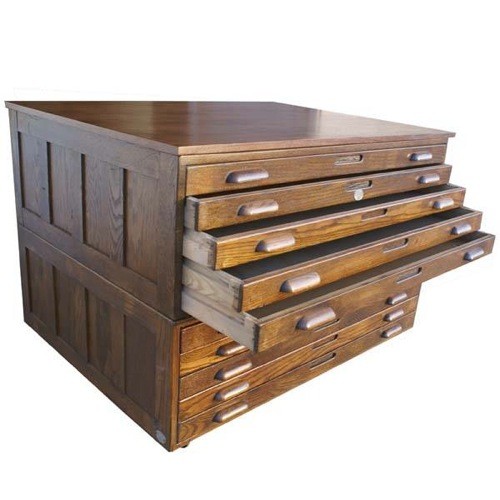
A standard filing cabinet is a tall, narrow box built around hanging vertical folders. A flat file is a completely different piece of furniture, built around the opposite constraint: wide, shallow horizontal drawers, deep enough only to slide a hand in and lift something out flat. That shape exists for one reason — some things genuinely cannot be folded, rolled or filed vertically without damaging them: architectural drawings, fine art prints, large-format photographs, maps, textile samples, and any document or artwork bigger than a standard folder. The drawer proportions aren't a style choice; they're dictated entirely by what has to lie flat inside them.
Who actually builds the serious versions today
The company most worth knowing about here is Hollinger Metal Edge, and it has a genuinely unusual origin for a furniture manufacturer: it wasn't founded by a furniture designer at all. William Hollinger founded the company in 1945 in Arlington, Virginia, and instead of starting with a product and looking for customers, he began by working directly with the Library of Congress and the National Archives to develop acid-free storage materials that met their actual preservation requirements. Those early collaborations effectively set the archival storage standards the rest of the industry has followed ever since — this is a company that helped write the rulebook for how you're supposed to store irreplaceable paper and artwork, rather than one that built cabinets first and called them "archival" afterward.
The company merged with Metal Edge in 2008 under Bob Henderson to become Hollinger Metal Edge, and today runs its manufacturing out of a dedicated facility in Fredericksburg, Virginia, with additional offices in California. Its client list is exactly who you'd expect given that founding story: government and institutional archives, historical societies, museums, libraries, universities and galleries, alongside private collectors who want the same storage standard those institutions use.
That founding work with the Library of Congress and National Archives had a real, lasting effect on the archival world beyond flat files specifically: the company's acid-free storage boxes became so standard that "Hollinger box" is now used as a generic term for a document storage box in archives generally, the way "Xerox" became shorthand for photocopying. The Smithsonian's Archives of American Art stores its collection folders in Hollinger cartons and metal-edge boxes today — a real, current institutional client rather than a historical footnote. The boxes themselves are made from 60-point acid-free, lignin-free board buffered with calcium carbonate to hold a neutral pH between 8.0 and 9.0, meeting standards set by the American National Standards Institute, the National Archives and the Library of Congress. That's the same underlying materials science and institutional trust the company's flat file cabinets are built on.
What actually makes their flat files different
The specifics matter here, because "archival quality" gets used loosely elsewhere. Hollinger Metal Edge's steel flat files use a genuinely no-off-gassing, archival-quality paint finish — meaning the cabinet itself won't slowly release the acidic compounds that ordinary painted steel or particleboard can leach into an enclosed drawer over years of storage, which is exactly the kind of slow, invisible damage that ruins irreplaceable paper and photographic materials. Drawers come in a few real depth options — 2⅛ inch drawers for standard flat storage, up to 4-inch heavy-duty drawers on ball-bearing suspension for bulkier material — and the cabinets are genuinely modular, built to be used as a single unit or stacked into a taller system as storage needs grow, in configurations of five or ten drawers. Chrome pull handles with built-in label holders are a small detail, but a meaningful one for anyone managing a real archive: you need to know what's in a given drawer without opening every one.
Worth it for a home or studio?
Not everyone storing large flat material needs museum-grade, no-off-gassing construction — a working architecture studio or a home art practice can reasonably use a cheaper contemporary steel flat file, or a genuine vintage oak unit like the one pictured above, without worrying about decades-long acid migration. But if what you're storing is genuinely irreplaceable — original artwork, family photographs, historical documents — the difference between an ordinary painted cabinet and an actual archival one isn't marketing language, it's the actual chemistry of what's in contact with your material for years at a time. That's the real case for looking at Hollinger Metal Edge's actual flat file range directly rather than treating "flat file" as a single undifferentiated product category.